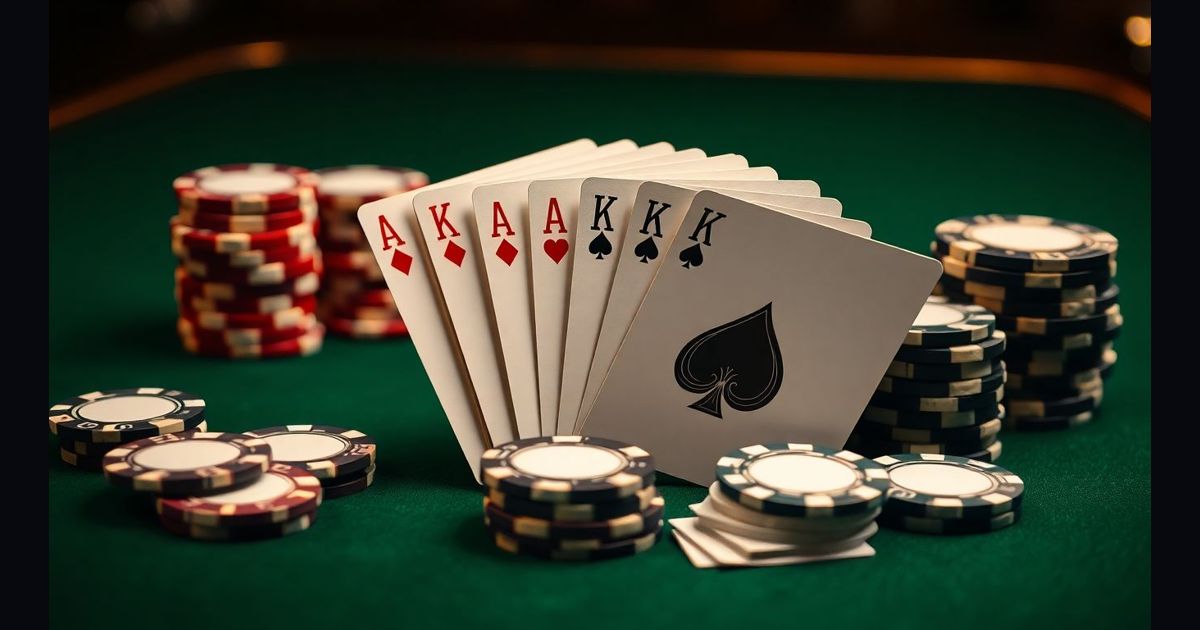
Here's a myth that keeps circulating through casino forums: Pai Gow Poker is just a dumbed-down version of real poker that casinos invented to fleece tourists. Dead wrong. This ancient Chinese domino game predates Texas Hold'em by centuries, and its poker variant offers some of the most favorable odds you'll find on any casino floor.
The confusion stems from the name similarity, but traditional Pai Gow uses 32 Chinese dominoes while Pai Gow Poker — developed by casino owner Sam Torosian in 1985 — adapts the splitting concept to standard playing cards. Both versions share the core mechanic of creating two separate hands to beat the dealer's corresponding hands.
Understanding Traditional Pai Gow Rules
Traditional Pai Gow uses a set of 32 Chinese dominoes, each featuring different dot combinations. Players receive four tiles and must arrange them into two hands: a high hand (worth more points) and a low hand (worth fewer points).
The tile rankings follow specific patterns based on dot totals and traditional combinations. Certain pairs like Gee Joon tiles (1-2 and 2-4 combinations) act as wild cards, making them the highest-ranking tiles in the set.
Each hand's value equals the rightmost digit when adding the dots on both tiles. A hand totaling 13 becomes worth 3 points, while a hand totaling 9 remains worth 9 points — the highest possible value.
To win, both your hands must beat both dealer hands. If you win one and lose one, the result pushes. Lose both hands, and you forfeit your bet.
Pai Gow Poker Adaptation
Pai Gow Poker simplifies the concept using a 53-card deck (standard deck plus one joker). Players receive seven cards and create a five-card high hand and a two-card low hand. The five-card hand must rank higher than the two-card hand using standard poker rankings.
The joker acts as a semi-wild card — it completes straights, flushes, and straight flushes, or becomes an ace in other situations.
Most Pai Gow Poker variants carry a house edge of 2.5% when played with basic strategy, making it more favorable than many popular table games.
Optimal Strategy for Traditional Pai Gow
Traditional Pai Gow strategy revolves around understanding tile combinations and point calculations. The Supreme combination (12-dot and 2-dot tiles) ranks highest, followed by matched pairs arranged by traditional hierarchy.
With mixed tiles, calculate potential point values for different arrangements. Generally, aim to make your high hand as strong as possible while ensuring your low hand can compete with common dealer holdings.
Advanced players memorize the Wong and Gong combinations — specific high-value pairings that often determine winning outcomes. Wong combinations total 10 or 11 points with specific tile pairings, while Gong combinations total 8 or 9 points.
Managing the Banking Option
Many casinos allow players to bank against other players and the house. Banking provides a mathematical advantage due to winning ties, but requires sufficient bankroll to cover all table action.
Calculate your edge before banking. With perfect play, banking reduces the effective house edge to approximately 0.25%, making it one of the lowest-edge opportunities in table gaming.
Bank only with adequate funds — you'll need roughly 20-30 times the average bet to handle variance safely.
Pai Gow Poker Strategy Breakdown
Pai Gow Poker strategy depends on your seven-card combination. With no pair, place your highest card in the five-card hand and your next two highest in the two-card hand.
One pair always goes in the five-card hand, with your highest remaining cards forming the two-card hand. This applies regardless of pair rank — never split aces or any other pair.
Two pair strategy varies by rank. Split high pairs (jacks through aces) with medium pairs (7s through 10s), keeping the higher pair in front. Keep small pairs together in the five-card hand if the other pair ranks 6s or lower.
Advanced Multi-Pair Situations
Three pair situations require placing the highest pair in your two-card hand while keeping the other pairs in the five-card hand. This maximizes your chances of winning both hands against typical dealer holdings.
Full house combinations get split — keep three of a kind in the five-card hand and move the pair to the two-card hand. This creates two strong hands instead of one dominant hand.
Two three-of-a-kinds (extremely rare) require keeping the lower trips in the five-card hand and splitting the higher trips, placing a pair in front.
House Edge Analysis Across Variants
Standard Pai Gow Poker with the 7-up commission structure (5% on wins) produces a house edge of 2.84% with basic strategy. This drops to 2.73% with optimal play.
No-commission variants alter payouts instead of charging fees. These versions typically push dealer ace-high hands or reduce banker blackjack payouts, resulting in house edges between 1.5% and 2.1% depending on specific rules.
Progressive side bets dramatically increase house edges, often exceeding 15%. The Pai Gow Insurance side bet carries a 7.1% house edge despite its modest appearance.
Regional Rule Variations
California card rooms use non-banked Pai Gow where players compete against each other with the house collecting fixed fees. This eliminates traditional house edge calculations, making session profitability dependent on opponent skill levels.
Some jurisdictions offer Pai Gow Mania, which adds three-card bonus hands and alters traditional strategy requirements. The base game maintains similar odds while side bets introduce additional house edges exceeding 3.5%.
Provider Comparisons in Digital Versions
Playtech's Pai Gow Poker maintains traditional rules with clean graphics and intuitive hand-setting assistance. Their version includes detailed strategy hints and statistical tracking, making it excellent for learning proper technique.
Microgaming's offering features faster gameplay and customizable table limits ranging from $1 to $500 per hand. The auto-arrange function follows optimal strategy for straightforward decisions while allowing manual override for complex situations.
RealTime Gaming provides the most authentic casino experience with realistic dealer animations and traditional commission structures. Their return-to-player rate of 97.15% reflects optimal strategy implementation.
Mobile Platform Performance
Evolution Gaming's live dealer Pai Gow Poker streams at 60fps with multiple camera angles. Professional dealers explain decisions and provide strategy guidance, creating an educational environment worth the slightly higher minimum bets.
Their hit rate of 41.5% for winning or pushing both hands aligns with mathematical expectations, confirming fair dealing practices across thousands of tracked decisions.
Bankroll Management Essentials
Pai Gow's frequent pushes create extended playing sessions with gradual bankroll fluctuations. Plan for 40-50 hands per hour at typical casino pace, with push rates approaching 40% under normal conditions.
Conservative bankroll management suggests 30-40 buy-ins for traditional Pai Gow Poker sessions. The game's lower variance means smaller swings but also limits big winning opportunities compared to other poker variants.
Commission costs accumulate quickly during winning streaks. Track these carefully — a successful session winning 10 hands generates $25 in fees at $10 minimum tables, representing a significant portion of potential profits.
Session Goals and Limits
Set realistic profit targets between 20-30% of your starting bankroll. Pai Gow's mathematical structure makes larger wins unlikely without extended play or banking opportunities.
Establish stop-loss limits at 50% of your session bankroll. The game's pace allows emotional decision-making during losing streaks, making predetermined limits crucial for long-term success.
Consider banking opportunities carefully. While mathematically advantageous, banking requires 8-12 times your normal bet size and introduces significant short-term variance that can overwhelm smaller bankrolls quickly.
Related coverage
Texas hold em rules: Complete Game Guide for 2026 · Betfair: Complete Game Guide for 2026 · Mgm casino: Complete Game Guide for 2026