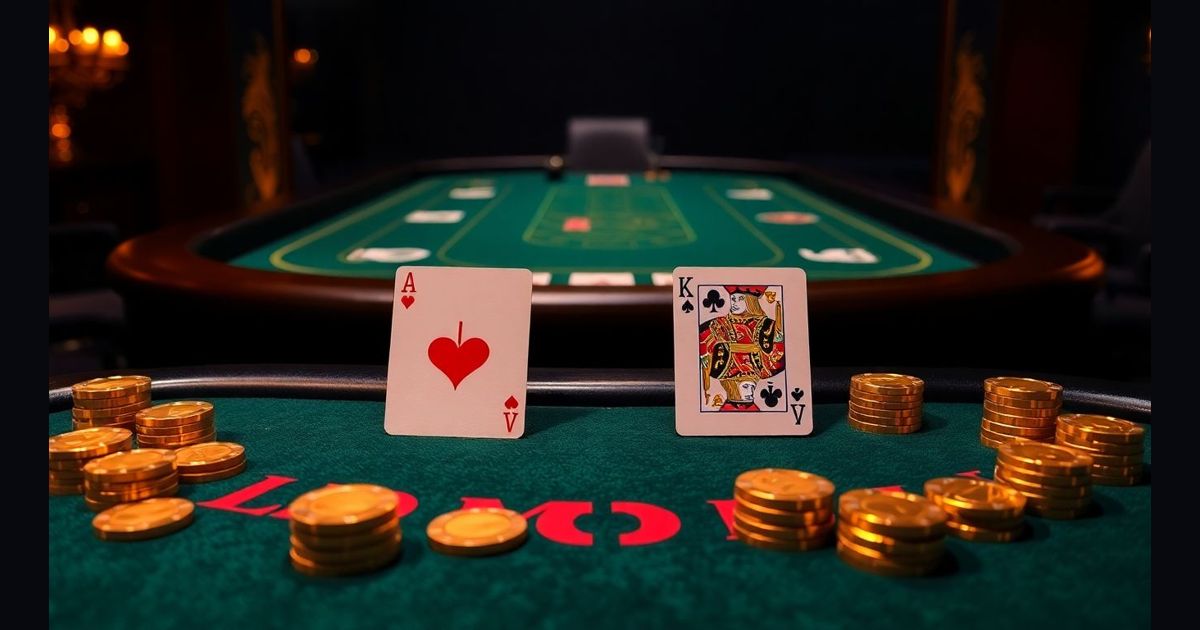
Most players think blackjack is about getting closest to 21, but professional advantage players know the real game is mathematical warfare against the house edge. While slot machines like NetEnt's Starburst lock you into a fixed 96.09% RTP, blackjack with perfect basic strategy delivers 99.5% RTP or higher — making it the most player-friendly game in any casino.
The gap between recreational and skilled blackjack play is massive. Poor decisions can inflate the house edge beyond 4%, worse than most penny slots. But master the fundamentals, and you're playing one of the few casino games where skill genuinely matters.
Understanding Blackjack Fundamentals
Card values form the foundation. Number cards count at face value, face cards equal 10, and aces count as either 1 or 11 depending on what benefits your hand most.
The dealer follows strict rules — they must hit on 16 or lower and stand on 17 or higher. This mechanical behavior creates exploitable patterns that smart players leverage.
Your goal isn't just reaching 21. You win by having a higher hand total than the dealer without exceeding 21, or by watching the dealer bust while you stay under 22.
Basic Strategy: Your Mathematical Foundation
Basic strategy represents decades of computer analysis determining the optimal play for every possible hand combination. Created by mathematicians like Edward Thorp in the 1960s, these charts reduce the house edge to roughly 0.5%.
Hard Hands (No Ace or Ace Counted as 1)
Always hit hard totals of 11 or lower — you can't bust.
Hit hard 12 against dealer 2 or 3, then against 7 through ace. Stand against 4-6.
Stand on hard 17 or higher regardless of dealer upcard. The bust risk outweighs potential gains.
Double down on hard 11 against any dealer upcard except ace. Double on hard 10 against dealer 2-9. Double hard 9 against dealer 3-6.
Soft Hands (Ace Counted as 11)
Soft hands offer flexibility since the ace prevents busting on the next card.
Always hit soft 17 or lower — you're guaranteed not to bust and might improve significantly.
Double soft 13-18 against dealer 5 or 6. Double soft 15-16 against dealer 4. Double soft 17-18 against dealer 3.
Stand on soft 19 or higher unless doubling is permitted against weak dealer upcards.
Pair Splitting Strategy
Always split aces and eights. Splitting aces gives you two chances at blackjack. Splitting eights turns a terrible 16 into two playable hands.
Never split tens, fives, or fours. A 20 is too strong to break up. Two fives equal 10 — just double instead. Fours create weak starting hands.
Split other pairs based on dealer upcard. Split 2s, 3s, 6s, and 7s against dealer 2-7. Split 9s against 2-9 except 7.
Advanced Concepts and Variations
Doubling Down Mechanics
Doubling down doubles your bet in exchange for receiving exactly one more card. This aggressive move maximizes value on strong starting hands against weak dealer positions.
Most casinos allow doubling on any two cards, but some restrict doubling to hard 10 or 11 only. These restrictions increase the house edge by approximately 0.25%.
Double after splitting adds another strategic layer. If you split 8s and receive a 3 on one hand, doubling that 11 against a dealer 6 creates massive value.
Surrender Options
Early surrender lets you forfeit half your bet before the dealer checks for blackjack. This rare rule reduces the house edge significantly, especially against dealer aces.
Late surrender allows folding after the dealer checks for natural blackjack. Surrender hard 15 against dealer 10, and hard 16 against dealer 9, 10, or ace.
Insurance and Even Money
Insurance bets pay 2:1 when the dealer shows an ace and has blackjack. The true odds make this a terrible bet for basic strategy players — the house edge on insurance exceeds 7%.
Even money offers 1:1 payment on your blackjack instead of waiting to see if the dealer ties. Mathematically identical to insurance, even money should be declined.
Common Rule Variations and Their Impact
Dealer Hitting Soft 17
Dealer hits soft 17 increases the house edge by 0.22% compared to dealer standing on all 17s. Adjust your strategy by hitting soft 18 against dealer ace instead of standing.
Blackjack Payouts
Traditional blackjack pays 3:2 on natural blackjacks. Many casinos now offer 6:5 payouts, which increases the house edge by 1.39% — making these games worse than many slot machines.
Deck Composition
Single-deck blackjack offers the lowest house edge at around 0.17% with optimal basic strategy. However, casinos compensate with rule restrictions like no doubling after splitting.
Six or eight-deck shoes are standard in most casinos. The house edge increases minimally, but card counting becomes significantly more challenging.
Bankroll Management and Session Strategy
Betting Unit Calculation
Proper bankroll sizing prevents ruin during inevitable losing streaks. A conservative approach uses betting units equal to 1/100th of your total blackjack bankroll.
Never bet more than 5% of your session bankroll on a single hand, even during positive counts if you're counting cards.
Session Limits and Discipline
Set win and loss limits before playing. A common approach stops at 50% losses or 100% gains relative to your session bankroll.
Avoid progressive betting systems like Martingale. These systems don't overcome the mathematical house edge and can create devastating losses during extended losing streaks.
Online vs. Live Casino Considerations
Random Number Generators
Online blackjack uses RNGs that shuffle after every hand, making card counting impossible. Focus purely on basic strategy optimization.
Live dealer blackjack deals from physical shoes, creating card counting opportunities for skilled players. However, penetration (percentage of cards dealt before shuffling) is often shallow.
Game Speed and Decision Time
Online blackjack plays significantly faster than live games. This speed increases hourly hands played, amplifying both wins and losses. Many software providers like Evolution Gaming offer side bet options that dramatically increase the house edge — avoid these completely.
Bonus Restrictions
Casino bonuses typically contribute blackjack play at reduced rates, often 10-20% compared to 100% for slots. Read wagering requirements carefully, as basic strategy's high RTP makes bonus clearing challenging within reasonable timeframes.
Practical Implementation Tips
Starting Your Blackjack Journey
Begin with free play versions to internalize basic strategy without financial pressure. Most major software providers like Microgaming and Playtech offer practice modes.
Use strategy cards during live play — most casinos permit these reference tools. Memorization comes with repetition, but accuracy matters more than speed initially.
Avoiding Common Beginner Mistakes
Never take insurance regardless of your hand strength. The mathematics never favor this side bet for basic strategy players.
Don't copy the dealer's strategy by hitting until 17. This approach creates a house edge exceeding 5% because you bust first and lose immediately.
Resist hunches and gut feelings. Basic strategy represents optimal play based on millions of computer simulations. Your intuition cannot improve upon mathematical certainty.
Mastering blackjack requires discipline, practice, and unwavering adherence to proven mathematical principles. Unlike slots where outcomes are purely random, blackjack rewards skilled players with some of the best odds available in casino gaming.
Related coverage
What is Free slots with bonus games? Explained Simply · What is Free online slots with bonus? Explained Simply · What is Discusting? Explained Simply
Related Resources
High RTP Slots · Bankroll Management · NetEnt · What Is RTP?